Open Dental Insurance Verification Workflow 2026
Open Dental Insurance Verification Workflow in 2026: Timing, Exceptions, and Automation
Insurance verification is the most expensive workflow your dental practice runs poorly. A single missed eligibility check creates a denied claim, an angry patient at checkout, a write-off, and a billing follow-up cycle that costs your team hours. Multiply that by even a 5 percent verification miss rate across 1,500 appointments a year and the revenue leak is real.
This is a complete 2026 walkthrough of how an Open Dental practice should run insurance verification end to end. It covers timing, the seven-step workflow, the exception cases that break automation, and where AI tools genuinely move the needle versus where they create new failure modes. If you run on Open Dental, this guide will let you redesign your verification process with confidence and decide whether to add automation, switch tools, or fix process first.
Why the workflow matters more than the verification tool
Most dental practices think of insurance verification as a single task: "check the patient's coverage." It is actually a sequence of seven discrete steps, each with its own exception cases, and each step depends on the one before it. If you automate step five before fixing step two, you will get cleaner failures faster, but not more revenue.
Dental insurance verification done correctly produces three outputs:
A clean eligibility and benefits summary in the patient chart before the appointment.
An accurate patient estimate that prevents checkout surprises.
A defensible audit trail for any claim that gets denied later.
The wrong question is "which verification tool should I buy." The right question is "where in my seven-step workflow am I leaking revenue, and is that a tool problem, a process problem, or a staffing problem." Answer that first, then pick the tool.
The seven-step Open Dental insurance verification workflow
Step 1: Capture insurance at scheduling
The first failure mode happens at the moment of booking. If your front desk does not capture insurance carrier, plan name, subscriber ID, group number, and the relationship to subscriber at scheduling, every downstream step becomes guesswork. New patients especially need to have insurance captured before the appointment is confirmed, not when they walk in.
In Open Dental, this means using the Patient Edit window to enter insurance plan details before the appointment is finalized in the appointments module. For new patients booking online, the booking flow should require insurance fields before the appointment slot is locked.
Step 2: Queue the patient in Open Dental's verification list
Open Dental's built-in insurance verification list is the right tool for this. It lets you flag patients whose benefits need verification and tracks the status (not verified, in progress, verified, exception). The verification list should be the single source of truth your insurance team works from each morning.
The most common process failure here is teams who verify ad hoc out of the daily schedule instead of working from a single queue. That leads to duplicate verifications, missed patients, and no clean audit trail.
Step 3: Run the eligibility and benefits check
For each patient in the queue, you need an eligibility check (is the policy active) plus a full benefits breakdown (deductibles, annual maximums, frequency limits, in-network vs out-of-network rates, waiting periods, prior authorization requirements, and procedure-level coverage for the planned visit).
Open Dental supports real-time eligibility through partnerships with clearinghouses and through its Ins Batch Verify functionality, which can run overnight via the Open Dental Service to verify large batches automatically (Arini Insurance Verification Integration Guide for Open Dental).
For practices that want richer benefits summaries than the standard 271 eligibility response provides, third-party AI verification tools can call the payer, extract a structured benefits breakdown, and write it back into Open Dental. Tools like tab32's AI Eligibility advertise real-time payer verification with coverage summaries broken down by visit type, including deductibles, annual maximums, frequency limits, in-network vs out-of-network rates, service history, and not-covered procedures (tab32 AI Eligibility).
Step 4: Write the benefits summary back to the chart
The benefits summary is useless if it lives in a PDF on the desktop. It needs to be written back to the patient's chart in Open Dental in a structured, searchable format. The clinical team should be able to glance at the patient screen and see deductible remaining, annual max remaining, frequency limits on the planned procedure, and any prior auth requirements.
This is where most low-cost verification services fail. They produce a benefits PDF and email it to the practice. The benefits never make it into Open Dental in a structured way, so the clinical team never sees them at the chair, and the front desk has to retype them into the estimate at checkout.
Step 5: Generate the patient estimate
With clean benefits in the chart, Open Dental can generate an accurate patient estimate for the planned procedure. The estimate should include the procedure fee, the insurance allowable, the patient portion, and any deductible still to meet for the year.
This estimate should be sent to the patient in advance of the appointment, ideally 48 to 72 hours out, so the patient arrives with no surprises. CECOmputeTech's dental insurance verification checklist recommends reviewing the schedule 48 to 72 hours prior to the appointment, verifying eligibility, in-network status, waiting periods, deductibles, annual maximums, frequency limits, and prior authorization (CECOmputeTech).
Step 6: Escalate exceptions to a human
No automation reaches 100 percent. The exception cases are where a human verifier needs to be involved. These include:
Patients whose plan returns "active" eligibility but no benefits breakdown.
Patients with secondary coverage that overrides primary in unexpected ways.
Patients whose group number does not match the plan in your system.
Patients with a Medicaid managed care plan that requires special handling.
Patients whose plan requires pre-authorization for the planned procedure.
A well-designed verification process routes these exceptions to a human early, ideally 5 to 7 days before the appointment, so there is time to resolve them. A poorly designed process catches them at checkout, which is when revenue leaks turn into checkout fights.
Step 7: Recheck on the date of service
For high-value procedures, especially crowns, implants, and surgical extractions, the final verification step is rechecking eligibility on the date of service. A policy that was active when verified 72 hours ago can lapse if the patient changed jobs or stopped paying premiums.
This is a low-cost, high-value insurance posture. The cost of a 30-second eligibility recheck on the date of service is essentially zero. The cost of a denied claim on a $1,500 crown procedure is hours of follow-up plus the risk of patient bad debt.
Timing matrix for Open Dental insurance verification
Timing | Action | Owner |
|---|---|---|
At scheduling | Capture insurance carrier, plan, subscriber ID, group, relationship | Front desk |
7 days before | Initial eligibility check in Open Dental | Insurance verifier |
5 to 7 days before | Resolve exceptions, request prior auth if needed | Insurance verifier |
48 to 72 hours before | Full benefits breakdown written to chart, patient estimate generated and sent | Insurance verifier or automation |
24 hours before | Confirm patient received estimate, address questions | Front desk |
Date of service | Recheck eligibility for high-value procedures | Front desk or automation |
At checkout | Collect patient portion based on already-validated estimate | Front desk |
The exception cases that break automation
If you are evaluating an AI insurance verification tool for your Open Dental practice, focus the conversation on exception handling, not happy-path verification. Every vendor will demo a clean PPO eligibility check that returns a complete benefits breakdown in 5 seconds. The real test is what the tool does when:
The payer returns "active" but provides no benefits detail. Does the tool fall back to a phone call, or does it leave the verification incomplete?
The patient has primary and secondary coverage with COB rules. Does the tool calculate combined benefits correctly, or does it surface only primary?
The patient's group number in your system is wrong. Does the tool tell you the policy is inactive, or does it suggest you check the group number?
The procedure code requires pre-authorization. Does the tool flag the requirement, or does it return benefits as if no pre-auth were needed?
The patient has a Medicaid managed care plan with carve-out dental benefits. Does the tool know how to handle the carve-out, or does it return commercial plan logic?
A tool that handles these exception cases gracefully is worth significantly more than a tool that has marginally better happy-path latency.
Where AI moves the needle, and where it does not
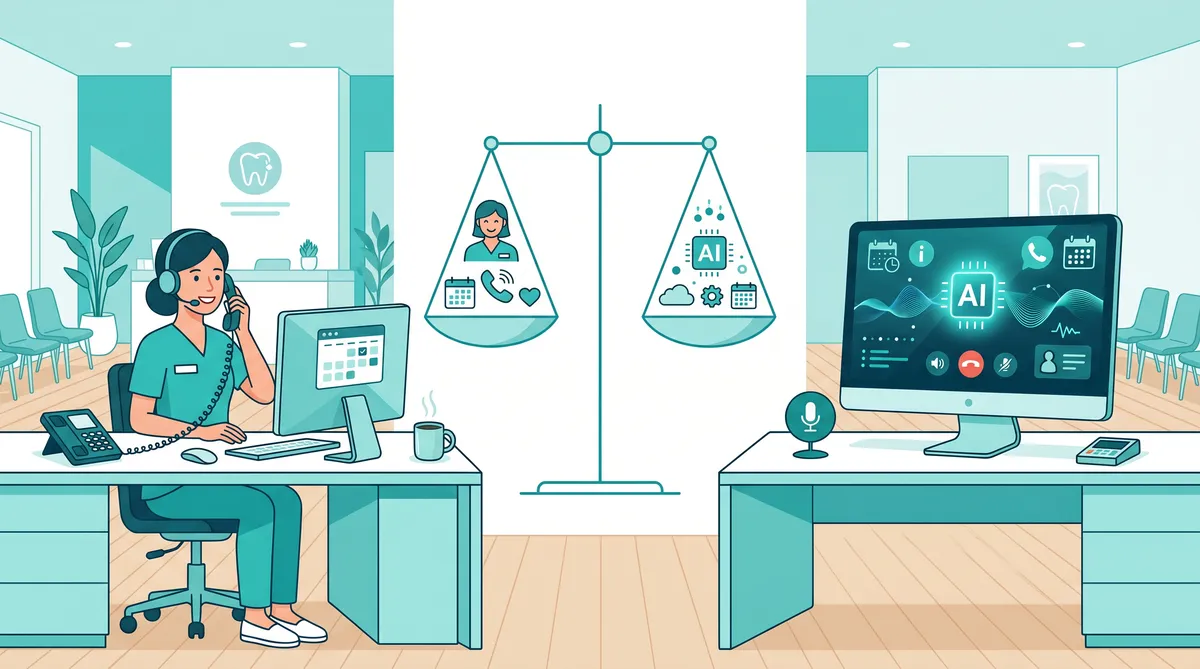
AI verification tools are genuinely useful in three places: pulling structured benefits breakdowns from payer responses faster than humans can, summarizing complex benefits into a single chart-ready paragraph, and running overnight batch verification on tomorrow's schedule without staff time. These three together can free up 10 to 20 staff hours per week in a mid-size practice.
AI verification tools are not useful, and are sometimes actively harmful, in three places: exception handling that requires payer phone calls, interpreting carve-out and managed Medicaid plans, and resolving carrier-specific quirks that only an experienced verifier knows. A tool that pretends to handle these cases when it cannot will create more work, not less.
The right architecture is AI for the 70 to 80 percent of verifications that run cleanly, and a structured exception queue routed to a human verifier within 48 hours for everything else.
How Mentera fits
Mentera is not a stand-alone insurance verification tool. It is an AI layer that sits on top of your existing Open Dental practice and provides AI Receptionist, AI Scribe, AI Insurance Handler, AI Patient Reactivator, and AI Search across your stack.
For Open Dental practices, this matters in three ways. First, the AI Insurance Handler reads from and writes to Open Dental directly, so verified benefits land in the chart in structured form rather than as a PDF attachment. Second, the AI Receptionist captures insurance at the moment of booking, so the verification queue is populated correctly from the start. Third, AI Search lets the team query across Open Dental, the verification data, and the communication log from one place, which collapses three or four lookups into one.
The key positioning point is that Mentera does not replace Open Dental. It plugs into it. Practices that have invested years configuring Open Dental are not asked to start over.
Frequently asked questions
How far in advance should a dental practice verify insurance for an Open Dental appointment?
Initial eligibility checks should run at least 7 days before the appointment to allow time to resolve exceptions and request prior authorizations. The full benefits breakdown and patient estimate should be ready 48 to 72 hours before the appointment, and a final eligibility recheck on the date of service is recommended for high-value procedures.
What is the difference between eligibility and benefits verification in Open Dental?
Eligibility verification confirms that the patient's policy is active and the patient is covered. Benefits verification goes further and pulls deductibles, annual maximums, frequency limits, in-network vs out-of-network rates, waiting periods, prior authorization requirements, and procedure-level coverage. Practices need both. Eligibility alone does not let you generate an accurate patient estimate.
Can Open Dental run insurance verification automatically?
Yes. Open Dental's Ins Batch Verify functionality, run via the Open Dental Service, can verify large batches of patients overnight using real-time clearinghouse eligibility responses. Third-party AI verification tools extend this with richer benefits summaries and exception handling.
What are the most common insurance verification mistakes that cause claim denials?
Failing to verify in-network status correctly, missing frequency limits on procedures, missing prior authorization requirements, missing waiting periods on new policies, and using a benefits summary that is older than the most recent policy change. Most of these are preventable with a 48-to-72-hour verification window and a strict exception escalation process.
Should a dental practice automate insurance verification or hire a verifier?
The right answer is usually both. Automate the happy-path verifications that account for 70 to 80 percent of your queue and free up a verifier's time for the 20 to 30 percent of exception cases that require judgment, payer phone calls, or carrier-specific knowledge.
How does an AI insurance handler work with Open Dental specifically?
A well-designed AI insurance handler integrates with Open Dental at the database level, reads the appointment schedule, populates the verification queue, runs eligibility and benefits checks through clearinghouses or direct payer connections, writes the structured benefits summary back to the patient's chart, generates the patient estimate, and surfaces exceptions to a human verifier through an escalation queue.
Ready to redesign your verification process?
If you want help mapping your Open Dental insurance verification workflow, identifying where revenue is leaking, and deciding whether automation, process redesign, or staffing changes will pay back fastest, book a Mentera demo. The team will walk through your current verification flow, your payer mix, and your exception rate, and give you an honest read on the highest-ROI change to make first.