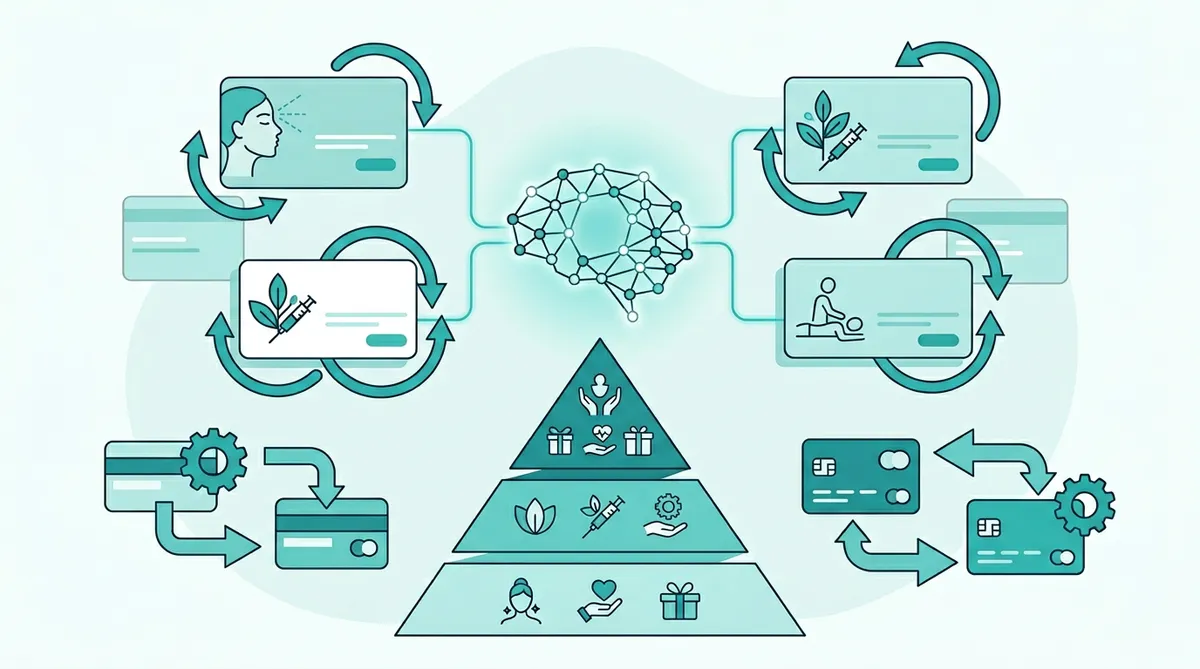
Med Spa Automation Roadmap: 30/60/90-Day Plan
Med Spa Automation Roadmap: What to Automate in Your First 30, 60, and 90 Days
Most med spa owners attempt automation the wrong way. They buy three tools at once, get overwhelmed, never finish onboarding, and end up paying for software that nobody on the team actually uses. Then they conclude "AI does not work for med spas." The problem is not the AI. The problem is the rollout sequence.
This is a practical med spa automation roadmap built around how aesthetic practices actually run. It is sequenced by ROI, by team change management capacity, and by the order in which automations build on each other. If you follow it, by day 90 you will have a measurable lift in chair utilization, retail attach, and after-hours capture, and your team will still be willing to use the system. The wrong order, and you will spend the same money and end up with three half-configured dashboards.
Why sequence matters more than tool choice
Aesthetic practices have a narrow operational window. Most med spas run with three to six clinical staff, one or two front desk, and an owner who is also the lead injector. There is no IT department. There is no time for a six-month implementation. Every new system has to start paying for itself within weeks or it gets abandoned.
That means automation has to deliver three things in order:
Capture lost revenue right now (calls, leads, after-hours bookings).
Free up staff hours so the team can focus on in-room experience and consultative selling.
Build the patient data layer that makes higher-leverage automations possible (reactivation, memberships, retail attach).
If you reverse the order, automations starve. You cannot run an effective reactivation campaign without first capturing the lead data. You cannot free up staff hours without first solving the after-hours phone problem that has them in early and out late. The roadmap below is built in that order.
Day 0: The two-hour audit before you buy anything
Before any tool decision, run a simple two-hour audit. You need three numbers and one decision.
The three numbers:
Missed call rate. Pull call data from your phone system for the last 30 days. Calculate the percentage of inbound calls that went to voicemail or were not picked up within 30 seconds. The industry benchmark for general practitioners shows non-attendance rates ranging from about 5 percent to 39 percent across studies, with telephone-based reminders consistently reducing missed appointments compared to no reminders (NHS Long Term Plan analysis, BMJ Open).
Average treatment value and lifetime value. Pull last year's revenue divided by unique patients, and average treatments per patient. This is the math you will use to justify every automation decision.
Chair utilization. What percentage of bookable hours actually had a patient in the chair last month? Most med spas land between 55 and 75 percent.
The one decision: what is your tolerance for change in the next 90 days? If your team is stretched and burned out, you should sequence slower and pick fewer tools. If you have a strong operations lead and a hungry team, you can compress the timeline.
Write these numbers down. Without them, every vendor will tell you their tool is the most important.
Days 1 to 30: Stop the bleeding
The first 30 days are about capturing revenue you are currently losing. Nothing else.
Week 1: Missed call recovery
Install an AI receptionist or missed-call text-back system that handles after-hours and overflow calls. Test it for a week in shadow mode (it answers but does not act) so your team trusts it. Then turn it on for after-hours only.
Success metric: by end of week 2, you are recovering at least 60 percent of after-hours calls into either booked appointments or warm leads in your CRM.
Week 2: Lead capture from web and social
Audit every lead source: website contact form, Instagram DM, Facebook lead form, Google Business Profile messages. Make sure every channel routes into a single inbox or CRM. Add an AI responder that replies within five minutes during business hours and books a consult.
The well-established research on lead response times shows the odds of qualifying a lead drop dramatically after the first five minutes (Harvard Business Review, "The Short Life of Online Sales Leads"). Most med spas reply in hours, not minutes. This is pure recoverable revenue.
Week 3: Automated appointment reminders and confirmations
Wire up SMS + email reminders at 72 hours, 24 hours, and 2 hours before each appointment. Allow patients to confirm, reschedule, or cancel by reply. Multiple meta-analyses including the Cochrane Review on appointment reminders have found that SMS reminders reduce no-show rates compared to no reminders, with effect sizes typically in the range of 4 to 8 percentage points for healthcare appointments.
Success metric: no-show rate drops by at least 25 percent from your baseline by end of week 4.
Week 4: Online booking that actually works
Your website should have a booking widget that loads in under two seconds, takes a deposit for new patients, and writes directly into your practice management system. If you cannot offer real-time booking without a phone call, you are losing the digital-native segment of your audience. A study in Frontiers in Digital Health found online-booked appointments had a 1.8 percent no-show rate compared to 5.9 percent for offline booking (Frontiers in Digital Health).
Day 30 checkpoint
By day 30, you should be able to point to three measurable wins:
After-hours and missed call recovery driving X new appointments per week.
Web/social leads getting a 5-minute response and booking at a higher rate.
No-show rate down 25 percent or more from baseline.
If you cannot point to those numbers, do not move to day 60. Diagnose what is not working and fix it before adding complexity.
Days 31 to 60: Free up staff hours
Once revenue capture is stable, the next 30 days are about giving your team back time. This is the part most owners skip because they jump straight to "fancy AI." You cannot scale clinical care if your team is drowning in admin.
Week 5: AI scribe in the treatment room
Deploy an AI scribe that captures the consultation, generates a structured note, and writes it to the chart. Even a 50 percent reduction in documentation time per appointment compounds fast. If your injector sees 15 patients a day and saves 4 minutes per patient on documentation, that is an hour back per provider per day. Use a scribe that integrates with your practice management software so the note lands in the right chart automatically.
Week 6: Insurance and benefits verification (where relevant)
Even cash-pay med spas often have a payment plan or HSA/FSA component. If you handle any insurance or financing, automate verification. The combination of real-time benefits checks plus automated estimate generation removes one of the most error-prone front-desk tasks. Done right, you eliminate 80 percent of patient billing surprises after the fact, which directly improves retention.
Week 7: Front desk AI assistant for routine questions
A high percentage of front-desk inbound conversations are repetitive: "how much is Botox," "do you offer financing," "what is your cancellation policy," "what is the parking like." Route these through an AI assistant on your website and SMS that can answer instantly and escalate edge cases. Your front desk should not be paid to answer the same five questions 40 times a day.
Week 8: Chart-prep automation for clinical staff
Before each appointment, the AI should pre-stage the chart with: patient's last treatment history, photos, pending consents, allergies, and any open issues from the prior visit. This is invisible automation. Patients never see it. But it shaves five to ten minutes off every appointment and dramatically improves the in-room experience.
Day 60 checkpoint
By day 60, your team should be reporting:
At least one hour per day per clinical provider freed up from documentation.
Front desk handling fewer repetitive calls, more revenue-generating ones.
Chart prep happening automatically before each appointment.
If your team is not feeling lighter at day 60, you have layered tools without consolidating workflow. Pull back.
Days 61 to 90: Build the patient data layer for compounding ROI
Days 61 to 90 are about turning the data you have been capturing into compounding revenue. This is where most practices see the biggest ROI lift, and it is also where most practices give up before getting to.
Week 9: Lapsed patient reactivation
You have 12 months of patient data now flowing cleanly. Segment patients who have not visited in 6, 9, and 12 months. Build a multi-touch reactivation sequence (email, SMS, optional voicemail) personalized to their last treatment. A med spa with 1,500 active patients typically has 200 to 400 lapsed patients worth tens of thousands in winback revenue.
Week 10: Membership and package nurture
If you offer memberships or treatment packages, automate the nurture flow. Patients who decline a membership at consult should receive a structured follow-up over the next 60 days. Members approaching their first renewal should get value-reinforcement content. This is the highest-LTV automation in aesthetics and it almost always pays for the entire stack on its own.
Week 11: Retail attach automation
After each treatment, automate the post-care follow-up with personalized product recommendations. Patients are most likely to buy retail in the 7 days after a treatment, while results are visible. Most med spas leave this on the table because the front desk does not have time. Automation closes it.
Week 12: Reviews and referrals
Patients are most likely to leave a review in the 24 to 48 hours after a positive treatment. Automate a review request with a one-tap link to Google, plus a referral incentive for delighted patients. Reviews are now an SEO and AEO ranking signal as well as a trust signal, so the compounding effect is real.
Day 90 checkpoint
By day 90, you should have:
A reactivation sequence running on autopilot driving net-new bookings from lapsed patients.
A membership and package nurture program lifting renewal and conversion rates.
A retail attach flow capturing post-treatment product revenue.
A reviews and referral flow building social proof and ranking signal.
The 30/60/90 sequence at a glance
Days | Focus | Automations | Success metric |
|---|---|---|---|
1 to 30 | Stop the bleeding | Missed call recovery, lead response, reminders, online booking | No-show down 25 percent, after-hours capture above 60 percent |
31 to 60 | Free up staff hours | AI scribe, benefits verification, front desk AI, chart prep | One hour per provider per day freed |
61 to 90 | Compounding ROI | Reactivation, membership nurture, retail attach, reviews | Net-new bookings and revenue per existing patient measurably up |
Why most med spa automation rollouts fail (and how this avoids it)
The pattern of failure is consistent across med spa automation rollouts. Owners try to install the day 60 or day 90 capabilities first, because reactivation and membership nurture sound exciting at the demo. But those automations depend on accurate, current patient data. Without the day 30 work (missed call capture, lead response, online booking), the data layer is incomplete. Without the day 60 work (AI scribe, benefits verification), the team has no spare capacity to respond to the leads the day 90 automations generate.
The other failure pattern is tool sprawl. Owners buy a separate vendor for each capability and end up with seven dashboards, three customer success contacts, and no single source of truth on a patient. The right approach is to pick an AI layer that sits across your existing practice management software and unifies the workflow, rather than replacing your stack three times in 90 days.
This is the structural advantage of using Mentera as the AI layer. Mentera's AI Receptionist handles the day 1 missed-call problem, Scribe AI handles the day 30 documentation lift, AI Insurance Handler handles benefits verification, AI Patient Reactivator handles the day 60 lapsed patient revenue, and AI Search lets your team query across all of it without retraining. Critically, none of this requires replacing your existing PMS, booking system, or marketing tools. The AI layer plugs in on top.
Frequently asked questions
How long does med spa automation actually take to roll out?
A disciplined rollout takes 90 days from contract signed to all three layers running. The most common reason rollouts stall is teams trying to deploy multiple capabilities simultaneously in the first 30 days. Sequencing one capability per week keeps the team's change-management bandwidth intact.
What is the first thing a med spa should automate?
Missed call and after-hours recovery. It is the single automation with the fastest payback and the lowest team-disruption cost, and it generates the lead data that every later automation depends on.
Do I need to replace my practice management system to add AI automation?
No. The fastest, lowest-risk path is an AI layer that integrates with your existing practice management system. Replacing your PMS is a 6 to 12 month project that delays automation ROI. An AI layer can be running within weeks.
What is a realistic ROI for med spa automation in the first 90 days?
Most well-implemented rollouts pay back the full annual cost of the stack within the first 60 to 90 days, driven by a combination of missed call recovery, no-show reduction, and lapsed patient reactivation. The compounding revenue from membership nurture, retail attach, and referrals typically lifts ROI by another 2 to 4 times in months 4 through 12.
How do I know if my team can actually handle a 90-day rollout?
The single best predictor is whether you have one named operations owner who can be the change-management lead. If automation is being driven by the owner-injector in spare time, the rollout will stall. Designate one person, give them four hours per week, and the 90-day plan is realistic.
Ready to map your first 30 days?
If you want help building a 30/60/90 automation plan tailored to your med spa, your existing PMS, and your team's capacity, book a Mentera demo. The team will walk through your current call volume, no-show rate, and lapsed patient list and show you where the first automations will pay back the fastest.